
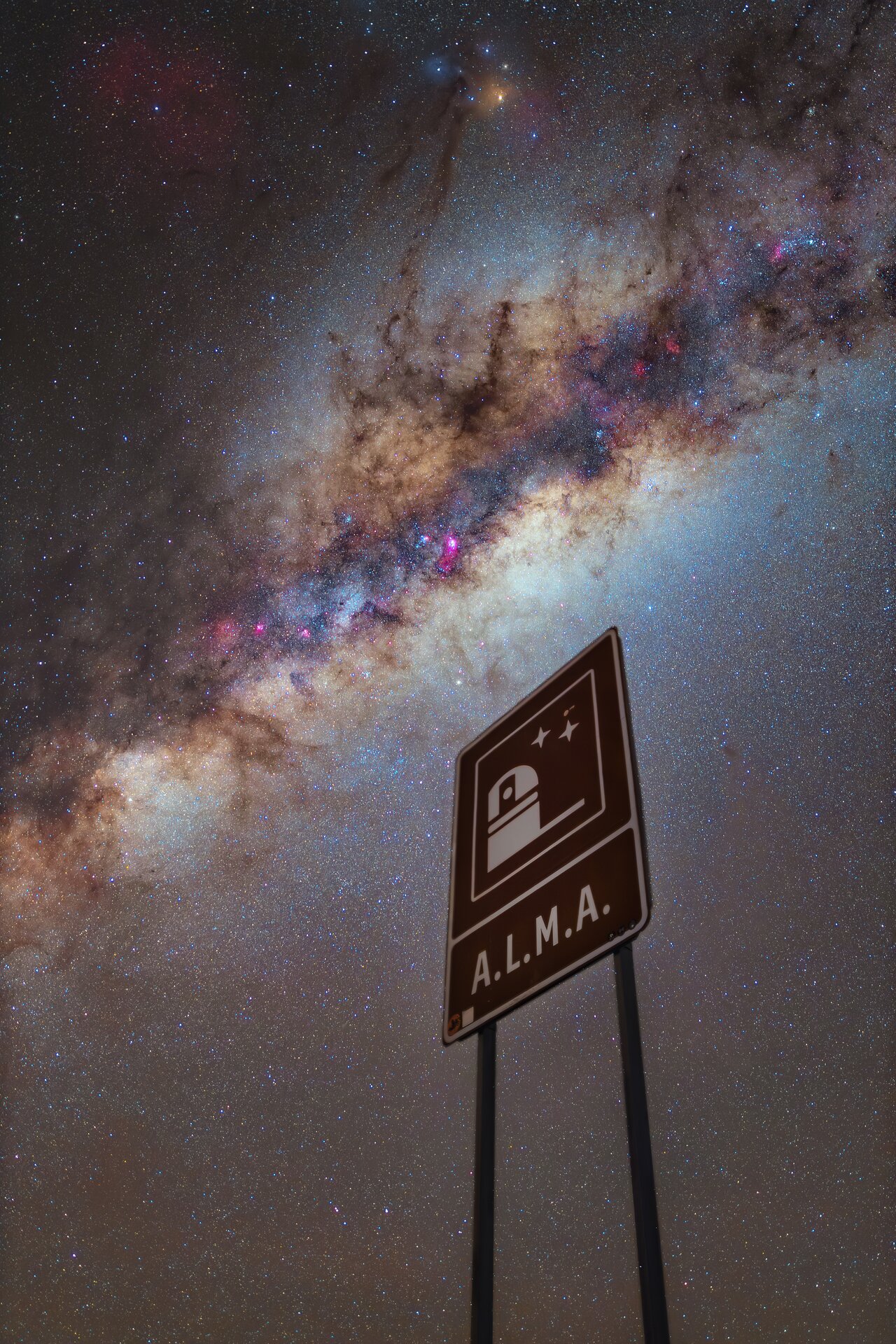
ALMA Reaches 5000 Refereed Publications
On 27 June, the 5000th refereed paper based on ALMA data was published. This landmark achievement illustrates the high scientific impact that ALMA has had in the astronomical scientific community. Note that all 5000 of these publications may be accessed through the ALMA Science Archive at almascience.org/aq.
ALMA at 15 years: Science, Synergies, and the Road Ahead
22-26 February 2027
Academia Sinica Nangang Campus
Taipei, Taiwan
Website
The fifteenth anniversary of ALMA’s first general science observations is approaching, and the ALMA organization will be organizing a conference in Taipei, Taiwan, to celebrate this anniversary. This conference will not only cover the latest results from ALMA but will also feature updates on the Wideband Sensitivity Upgrade, ALMA tutorial sessions, and discussions on future ALMA developments.
Abstract submissions are now open; see the submission information page for instructions and for links to the submission form. The deadline for submissions in 15 September, with notifications about accepted abstracts to be sent out in late October or early November.
ALMA2040 Call for White Papers
ALMA2040 is an initiative guiding the development of the next-generation millimetre/submillimetre interferometric facility for the 2040s. The goal is to first define the astronomical community’s key science priorities and then to use this information to instruct the design of the next-generation observatory, which may include features such as hundreds of new antennas, improved angular resolution or maximum recoverable scales, or broader frequency coverage. The science topics include the emergence and evolution of galaxies and black holes, the evolution of the cosmic baryon cycle in galactic ecosystems, the life cycle of planetary systems, and the physics of the extreme universe.
ALMA2040 is still at the stage where the initial science goals are still being defined, and everyone from the astronomical community is invited to get involved. The ALMA2040 call for white papers is currently at the writing stage, and people are still invited to join the process. The deadline for white paper submissions will be 20 September. See the ALMA2040 website for more information about the overall program.
UKSRC Webinar Series - Sharing the Sky and Stars: building authentic partnership with local and Indigenous communities
07 July 2026 11:00-12:00 BST
Registration
William Garnier and Liz Williams from the SKAO will be presenting a webinar on 07 July at 11:00-12:00 BST with the following abstract:
Building a 50-year observatory across two continents — in places that never asked for a telescope — demands a different kind of engagement. In this webinar we share what SKAO has learned about working with the local and Indigenous communities at both our sites: the Karoo in South Africa, and Wajarri Yamaji Country in Western Australia. Neither had a built-in audience of science supporters or an engagement baseline to build from — so engagement and the science have had to grow together.
We will look at how this partnership shapes the project and the Observatory, not the other way round: from contractor obligations on local and Indigenous hiring and upskilling, to SARAO’s long-running Human Capital Development programme, among many examples. Going beyond compliance, we argue, is not a bonus — it’s what makes a generational facility durable.
In Australia, the Wajarri Yamaji People gifted a Wajarri language name for the observatory site where the SKA-Low telescope is being built, Inyarrimanha Ilgari Bundara, the CSIRO Murchison Radio-astronomy Observatory. Inyarrimanha ilgari bundara means 'Sharing the Sky and Stars', and the Cosmic Echoes exhibition is one of the ways we live up to that. The second half of the webinar focuses on this art exhibition, which brings together Indigenous and local artists from around both sites to share their own stories of the sky, the land and the cosmos — and explores why art, alongside science, is one of the most powerful tools for two-way engagement, giving communities agency over how their knowledge and culture are represented on the national and global stages.
UK ALMA Regional Centre Support Information and Contact Details
The UK ALMA Regional Centre Node is available to provide support to people working with or interested in working with ALMA. This may include help with preparatory data analysis, including the use of archival data, proposal and observing preparation, data calibration and imaging, and subsequent data analyses. We can also provide computing facilities for ALMA data processing and training for individuals or groups of people.
If you have any ALMA science results that they want to share with the UK ALMA community, please contact us, and we will endeavour to include those results in our next newsletter and on our website.
For any ALMA-related queries or support requests, please contact the UK ARC Node via the following:
ALMA Helpdesk: help.almascience.org
Email:
Web: www.alma.ac.uk